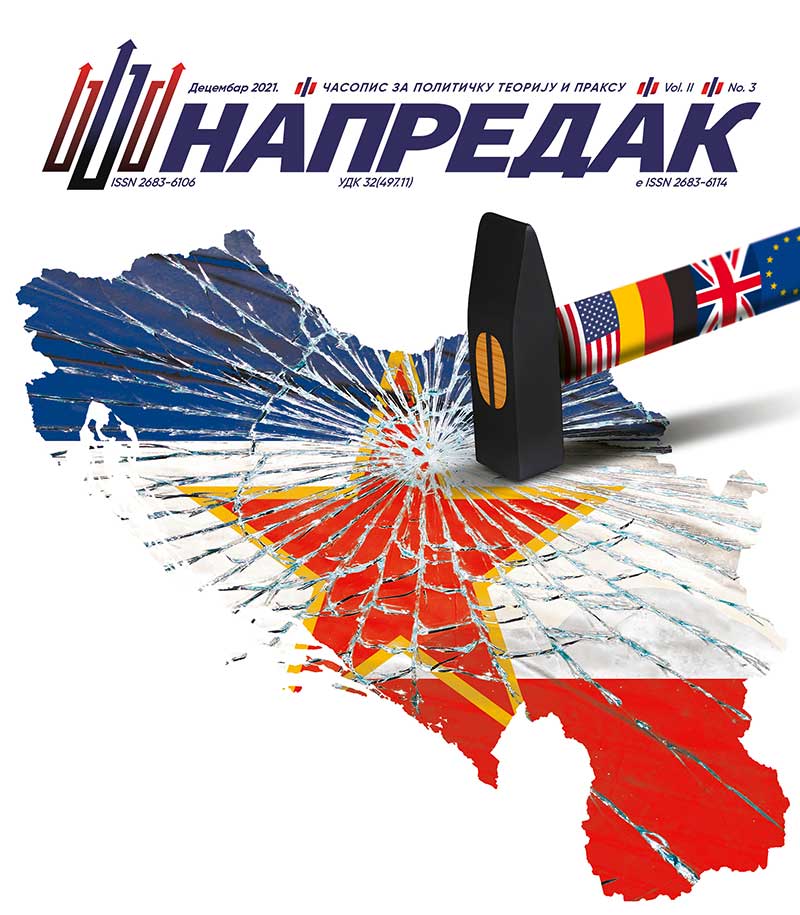
The disintegration of Yugoslavia and the Soviet Union: similarities and differences
Abstract
The aim of the analysis of this paper is to consider the important factors in the disintegration of the Socialist Federal Republic of Yugoslavia (hereinafter SFRY) and the Union of Soviet Socialist Republics (hereinafter USSR). The basic assumption is that there is a certain correlation, i.e., similarities and differences between the two processes. During the research of this question, standard methods were applied, such as analysis, synthesis, the historical method, comparative method, and the content analysis method, and in a sense, modeling or searching for a way to avoid the problems our country has faced over the past decades. Research has shown that this topic is still important for at least three reasons. First, it is obvious that the breakup of the SFRY and the USSR caused significant and multifarious problems in those countries, their successors, and beyond. Secondly, the security of these regions is still unstable and almost none of the problems that led to the conflicts of the 1990s and the disintegration of these countries have been completely resolved. Third, various challenges, the Republic of Serbia and the Russian
Federation, the main successors of the two countries, continue to experience risks and threats to their international position, defense, and security. Although the research showed that there is a certain correlation between the two processes - the disintegration of the SFRY and the USSR, it is obvious that this was not the decisive factor that led to the destruction of these two complex states, but that in both cases certain specific factors were decisive.
References
Avramov, S. (2008). Post-heroic war of the West against Yugoslavia. Belgrade: Akademija za diplomatiju i bezbednost [In Serbian]
Bžežinski, Z. (1999). The great chessboard. Podgorica: CID [In Serbian]
Čomski, N.(2018). Yugoslavia – peace, war and dissolution. Belgrade: SAMIZDAT B92 [In Serbian]
Dašić, D. (2019). Just societies. Belgrade: Albatros Plus [In Serbian]
Dugin, A. (2004). Foundations of geopolitics, vol. 1. Zrenjanin: Ekopres [In Serbian]
Dugin, A. (2004). Foundations of geopolitics, vol. 2. Zrenjanin: Ekopres [In Serbian]
Fursov, A. (2012). Transnational states against national states. In: B. Kuljanin (ed) Russia and the Balkans in the modern world. Banja Luka: Udruženje „Srpsko-ruski most“ [In Serbian]
Has, R. (2017). The world in disarray. Belgrade: CIRSD [In Serbian]
Krga, B. (2012). Geopolitical aspects of the dissolution of the SFRY and the USSR: similarities and differences. In: B. Kuljanin (ed.) Russia and the Balkans in the modern world. Banja Luka: Udruženje „Srpsko-ruski most“ [In Serbian]
Popov, Č. (2008). Greater Serbia: reality and myth. Novi Sad: Izdavačka knjižarnica Zorana Stojanovića [In Serbian]
Radinović, R. (2015). The nature of the wars to destroy Yugoslavia. Belgrade: Beogradski forum za svet ravnopravnih [In Serbian]
Živanov, S. (2002). Russia during Yeltsin. Belgrade: Fakultet političkih nauka [In Serbian]
https://regnum.ru/news/economy/444083.html
https://www.rbc.ru/politics/17/03/2021/6051a7c29a794759599b234b
Дневни лист Политика, 9. 5. 2021.