
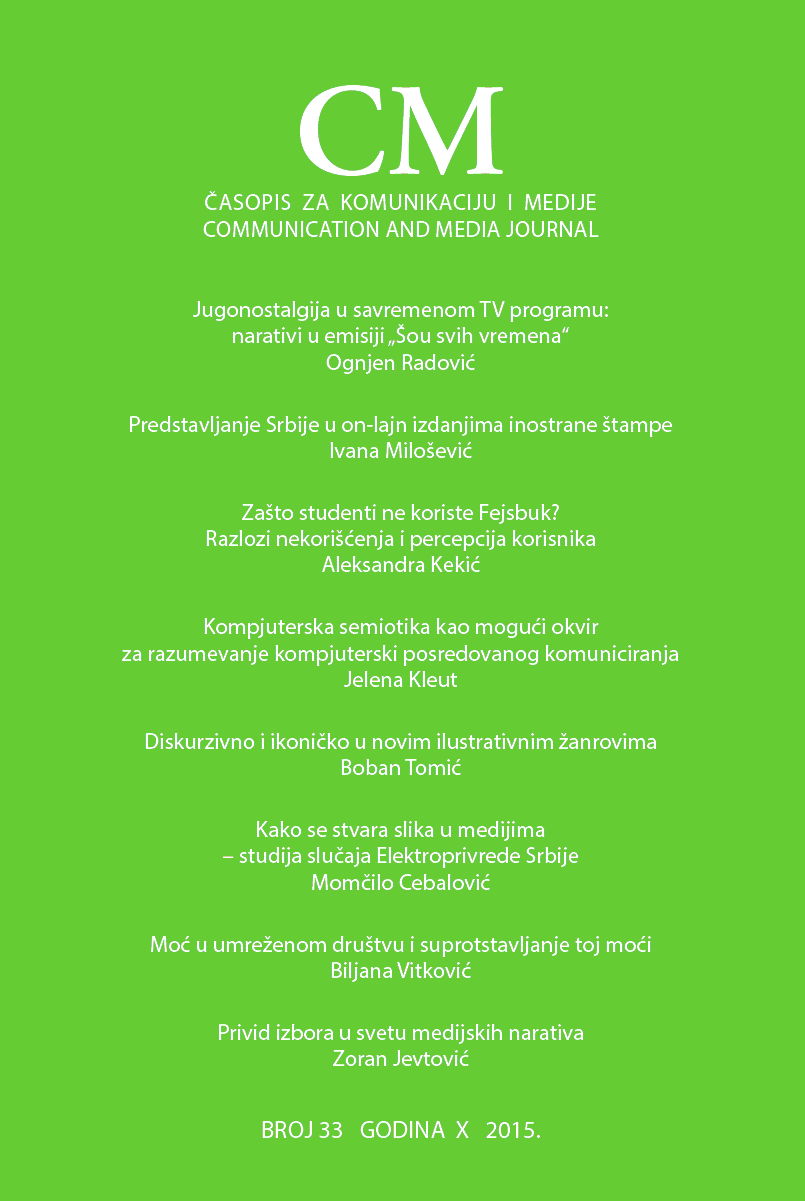
How a media image is created - A case study of Electric Power Industry of Serbia
Abstract
The media significantly influence the creation of public sector image in Serbia, especially public companies whose sale was announced by the government representatives. For this reason, a quantitative and qualitative analysis of media reporting was performed on ten most influential daily newspapers (Politika, Blic, Informer, Kurir, Nase novine, Vecernje novosti, Dnevnik, Danas, ALO and Pregled) and three weekly ones (NIN, Vreme and Novi magazin) throughout two periods - from 28.4 to 15.5.2014 and from 1.6 until 23.6.2014.
The aim of the study was to determine whether the media create image of Public Enterprise Electric Power Industry of Serbia (EPS) which should be privatized, if there are trends in creating that image and which sources of information presented to public are most visible. By analyzing the content we searched for an answer to whether these media apply investigative reporting and use analytical articles.
The analysis revealed that the media strongly influence the image creation that EPS needs to be sold, that this is a tendency and that media give more space to advocates of this idea. During the studied periods there were 59 news releases, of which 31 (52.5%) advocated for the sale, against were 15 (25.4%), and neutral 13 news releases (22.1%). From a total of 70 statements, privatization has also been suggested in 38 statements (54.3%), 23 statements (32.8%) were against, while there was 9 neutral statements (12.9%). The research has demonstrated that by superficial reporting media misinform the public, use half-truth and spinning and that such writings contain elements of propaganda.
References
Beta (26.1.2014). Lazar Krstić, ministar finansija u Vladi Srbije.
Čomski, N. (2002). Mediji, propaganda i sistem. Zagreb: Društvo za promicanje književnosti na novim medijima.
Čomski, N. Deset strategija manipulacija ljudima (n.d.). Posećeno 12.10.2014. URL: http://www.medijskapismenost.org/dokument/comski:-Deset-strategija-manipulacije-ljudima.
Gubitak javnih preduzeća dva puta veći od gubitka cele privrede (1.07.2014). Nova ekonomija, br. 12. Posećeno 18.9.2014. URL: http://javnapreduzeca.rs/12_gubitak_javnih_preduzeca_dva_puta_veci_od_gubitka_cele_privrede.php.
Fiskalni savet (2014a). Analiza preduzeća u državnom vlasništvu: fiskalni aspekt. Posećeno 19. 9. 2014. URL: http://fiskalnisavet.rs/doc/ocene-i-misljenja/analiza_preduzeca_u_drzavnom_vlasnistvu-fiskalni_aspekt.pdf.
Fiskalni savet (2014b). Analiza preduzeća u državnom vlasništvu: fiskalni aspekt – rezime. Posećeno: 19. 9. 2014. URL: http://fiskalnisavet.rs/doc/ocene-i-misljenja/rezime-analiza_preduzeca_u_drzavnom_vlasnistvu-fiskalni_aspekt.pdf .
Habermas, J. (1969). Javno mnjenje. Beograd: Kultura.
Jevtović, Z. (2003). Javno mnenje i politika. Beograd: Akademija lepih umetnosti – Centar za savremenu žurnalistiku.
Kramaršič, M. (prir.) (2012). Napoleon i Gebels – majstori propaganda. Beograd: Kramaršič, M.
Malović, S. (2006). Činjenicama se loše piše. Vijenac, br. 333. Posećeno: 15.9.2014. URL: http://www.matica.hr/vijenac/333/%C4%8Cinjenicama%20se%20lo%C5%A1e%20pi%C5%A1e/.
Ministarstvo finansija Republike Srbije (2013). Program mera za reformu javnog sektora. Posеćeno 18. 9. 2014. URL: http://www.mfin.gov.rs/UserFiles/File/Reforma%20javnog%20sektora/Program%20mera%20za%20reformu%20javnog%20sektora%2003_07_.pdf.
Šušnjić, Đ. (2008). Ribari ljudskih duša. Beograd: Čigoja štampa.
Tomić, Z. (2003). Komunikologija. Beograd: Čigoja štampa.
Volkov, V. (2002). Dezinformacija – od Trojanskog konja do Interneta. Beograd: Naš dom.
Vuković, V. (2014). Javni sektor u Srbiji: između mita i stvarnosti. Regionalni portal Bilten Posećeno 15.10.2014. URL: http://www.bilten.org/?p=1032.
Zakon o budžetskom sistemu (2013). Službeni glasnik RS, br. 54/2009, 73/2010, 101/2010, 101/2011, 93/2012, 62/2013, 63/2013 - ispr. i 108/2013.
Copyright
Authors retain copyright of the published papers and grant to the publisher the non-exclusive right to publish the article, to be cited as its original publisher in case of reuse, and to distribute it in all forms and media.
Licensing
The published articles will be distributed under the Creative Commons Attribution ShareAlike 4.0 International license (CC BY-SA). It is allowed to copy and redistribute the material in any medium or format, and remix, transform, and build upon it for any purpose, even commercially, as long as appropriate credit is given to the original author(s), a link to the license is provided, it is indicated if changes were made and the new work is distributed under the same license as the original.
Users are required to provide full bibliographic description of the original publication (authors, article title, journal title, volume, issue, pages), as well as its DOI code. In electronic publishing, users are also required to link the content with both the original article published in CM: Communication and Media and the licence used.
Authors are able to enter into separate, additional contractual arrangements for the non-exclusive distribution of the journal's published version of the work (e.g., post it to an institutional repository or publish it in a book), with an acknowledgement of its initial publication in this journal.
Self-archiving policy
Authors are permitted to deposit author’s publisher's version (PDF) of their work in an institutional repository, subject-based repository, author's personal website (including social networking sites, such as ResearchGate, Academia.edu, etc.), at any time after publication.
Full bibliographic information (authors, article title, journal title, volume, issue, pages) about the original publication must be provided and links must be made to the article's DOI and the license.
Disclaimer
The views expressed in the published works do not express the views of the Editors and the Editorial Staff. The authors take legal and moral responsibility for the ideas expressed in the articles. Publisher shall have no liability in the event of issuance of any claims for damages. The Publisher will not be held legally responsible should there be any claims for compensation.