
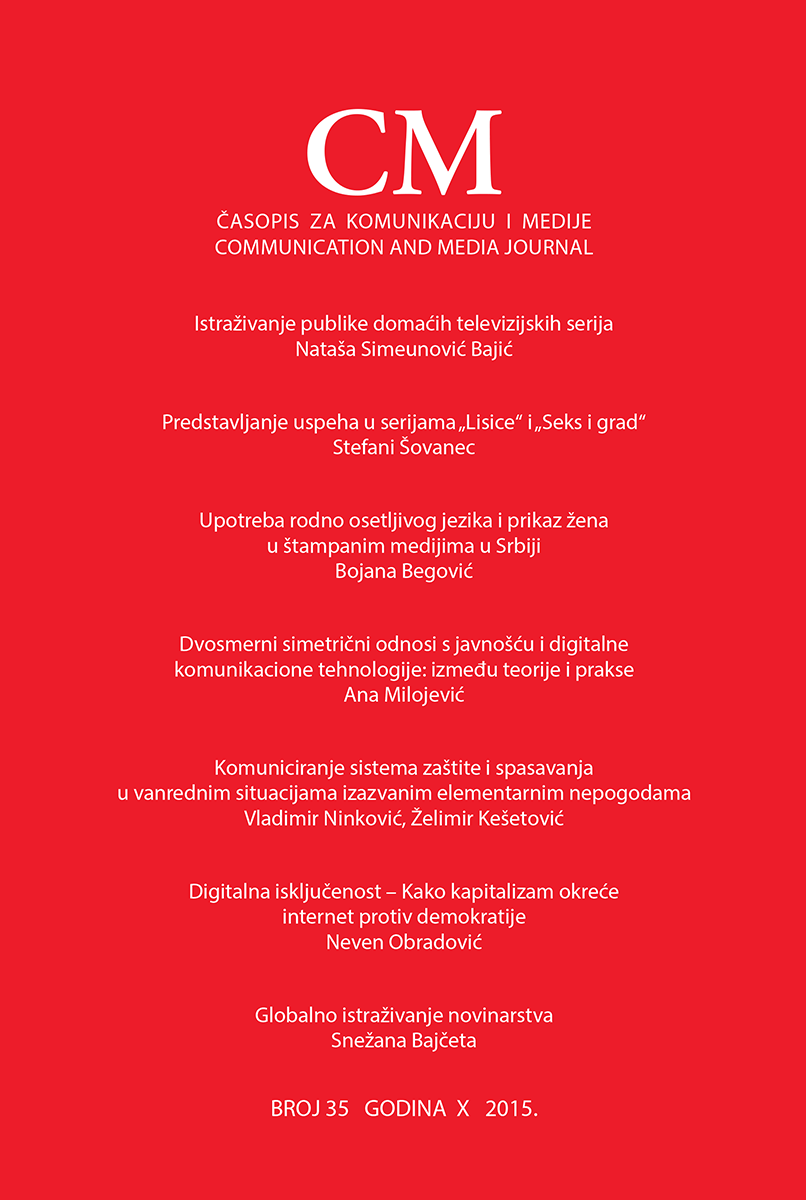
Upotreba rodno osetljivog jezika i prikaz žena u štampanim medijima u Srbiji
Sažetak
Borba za rodnu ravnopravnost može se sagledati kroz prikaz žene u medijima, kao kreatorima javnog mnjenja. Cilj rada je analiza korišćenja rodno osetljivog jezika i reprezentacija žena u u političkim rubrikama štampanih medija u Srbiji: Blicu, Kuriru i Danasu. Prilikom istraživanja korišćena je kvantitativna i kvalitativna analiza diskursa. Prikupljen materijal obrađen je po jedinstvenom kodnom sistemu koji je prilagođen za štampane medije. Korpus za analizu čine medijske objave izabranih medija u periodu od 1. do 7. juna 2015. godine.
Rezultati istraživanja ukazuju na zaključak da je upotreba rodno osetljivog jezika u razmatranim medijima na relativno zadovoljavajućem nivou i da štampani mediji u Srbiji, kada je reč o tekstovima iz oblasti politike, najčešće ne sadrže diskriminaciju prema ženama. Međutim, muškarci su dominantno zastupljeni u medijima, posebno u sferi politike. Žene se spominju retko, a kada se spominju, uglavnom nisu protagonistkinje priče. To ukazuje na to da se i dalje mora raditi na obrazovanju građanki i građana, posebno onih na javnim funkcijama.
Reference
Baćanović, V. (2008). Uvodnik - Kandidatkinje. U D. Valić Nedeljković (ur.), Kandidatkinje (str. 13–23). Novi Sad: Novosadska novinarska škola.
Etički kodeks elektronskih medija (2002). Posećeno 1.2.2016. URL: http://www.anem.rs/sr/oAnemu/etickiKodeks/EtickiKodeks.html.
Filipović, J. (2011). Rod i jezik. U I. Milojević & S. Markov (ur.), Uvod u rodne teorije (str. 409–423) Novi Sad: Mediterran Publishing.
Filipović, J. & Kuzmanović Jovanović, A. (2012). Vodič za rodno osetljiv pristup medijima u Srbiji. Beograd: Uprava za rodnu ravnopravnost.
Knežević, S. & Car V. (2011). Žene u televizijskim vijestima – analiza središnjih informativnih emisija HTV-a, RTL-a i Nove TV. Medijske studije, 2(3–4): 76–93.
Kodeks Novinara Srbije (2008). Posećeno 1.2.2016. URL: http://www.mc.rs/medijska-politika.825.html.
Korać, N. & Vranešević, J. (2011). Nevidljivo dete. Beograd: Centar za prava deteta.
Makluan, M. (1971). Poznavanje opštila - čovekovih produžetaka. Beograd: Prosveta.
Milinović, J. & Savić, S. (2011). Misterije rodne ravnopravnosti i još ponešto. Banja Luka: Helsinški parlament.
Milić, A. (2011). Feministički talasi, orijentacije i pokret u jugoslovenskom i srpskom društvu 20. veka. U I. Milojević i S. Markov (ur.), Uvod u rodne teorije (str. 51–64). Novi Sad: Mediterran publishing.
Milić, V. (1965). Sociološki metod. Beograd: Nolit.
Milošević, M. (2005). Novinarstvo i etika u Srbiji 2005. Beograd: Medija centar.
Momčilović, V. (2012). Analiza medijskog diskursa. Prikaz žene u nedeljnicima Novi magazin, Vreme i NIN u toku predizborne kampanje 2012. godine u Republici Srbiji. Posećeno 22. 12. 2016. URL: http://www.academia.edu/5419440/Analiza_medijskog_diskursa__prikaz_%C5%BEene_u_nedeljnicima_Novi_Magazin_Vreme_i_NIN_u_toku_predizborne_kampanje_2012._godine_u_Republici_Srbiji.
Mršević, Z. (2011). Ka demokratskom društvu – rodna ravnopravnost. Beograd: Institut društvenih nauka.
Pralica, D. (2012). Medijska sfera. Koga su mediji izabrali… a šta su partije nudile? Novi Sad: Novosadska novinarska škola.
Savić, S. (2004). Žena skrivena jezikom medija: Kodeks neseksističke upotrebe jezika. Novi Sad: Futura publikacije.
Savić, S. (2006). On je rekla – upotreba rodno senzitivnog jezika. Podgorica: Kancelarija za ravnopravnost polova Vlade Republike Crne Gore.
Savić, S. (2009). Rod i jezik. U S. Savić, M. Čanak, V. Mitro, G. Štasni (prir.), Rod i jezik. Novi Sad: Ženske studije i istraživanja i Futura publikacija.
Stojaković, G. (2011). Prilog za istoriju ženskog pokreta u Vojvodini i Srbiji u 19. i 20. veku. U I. Milojević i S. Markov (ur.), Uvod u rodne teorije (str. 65-81). Novi Sad: Mediterran publishing.
Todorović, N. (2002). Interpretativno i istraživačko novinarstvo. Beograd: Čigoja štampa.
Van Dijk, T. A. (1998). The Study of Discourse. Discourse as Structure and Process – Discourse Studies: A Multidisciplinary Interduction. London: Sage Publication. Volume 1: 1–34.
Vasiljević, L. & Anđelković, V. (2009). Priručnik za medije. Beograd: Ženski INDOK centar.
Autori zadržavaju autorska prava nad objavljenim člancima, a izdavaču daju neekskluzivno pravo da članak objavi, da u slučaju daljeg korišćenja članka bude naveden kao njegov prvi izdavač, kao i da distribuira članak u svim oblicima i medijima.
Licenciranje
Objavljeni članci distribuiraju se u skladu sa licencom Creative Commons Autorstvo - Deliti pod istim uslovima 4.0 International (CC BY-SA). Dopušteno je da se delo kopira i distribuira u svim medijima i formatima, da se prerađuje, menja i nadograđuje u bilo koje svrhe, uključujući i komercijalne, pod uslovom da se na pravilan način citiraju njegovi prvobitni autori, postavi link ka originalnoj licenci, naznači da li je delo izmenjeno i da se novo delo objavi pod istom licencom kao i originalno.
Korisnici su pri tome dužni da navedu pun bibliografski opis članka objavljenog u ovom časopisu (autori, naslov rada, naslov časopisa, volumen, sveska, paginacija), kao i njegovu DOI oznaku. U slučaju objavljivanja u elektronskoj formi takođe su dužni da postave HTML link, kako sa originalnim člankom objavljenim u časopisu CM: Communication and Media, tako i sa korišćenom licencom.
Autori mogu da stupaju u zasebne, ugovorne aranžmane za neekskluzivnu distribuciju rada objavljenog u časopisu (npr. postavljanje u institucionalni repozitorijum ili objavljivanje u knjizi), uz navođenje da je rad prvobitno objavljen u ovom časopisu.
Politika samoarhiviranja
Autorima je dozvoljeno da objavljenu verziju rada deponuju u institucionalni ili tematski repozitorijum ili da je objave na ličnim veb stranicama (uključujući i profile na društvenim mrežama, kao što su ResearchGate, Academia.edu, itd.), na sajtu institucije u kojoj su zaposleni u bilo koje vreme nakon objavljivanja u časopisu.
Autori su obavezni da pritom navedu pun bibliografski opis članka objavljenog u ovom časopisu (autori, naslov rada, naslov časopisa, volumen, sveska, paginacija) i postave link, kako na DOI oznaku tog članka, tako i na korišćenu licencu.Autorima je dozvoljeno da objavljenu verziju rada deponuju u institucionalni ili tematski repozitorijum ili da je objave na ličnim veb stranicama (uključujući i profile na društvenim mrežama, kao što su ResearchGate, Academia.edu, itd.), na sajtu institucije u kojoj su zaposleni u bilo koje vreme nakon objavljivanja u časopisu.
Odricanje od odgovornosti
Stavovi izneti u objavljenim radovima ne izražavaju stavove urednika i članova redakcije časopisa. Autori preuzimaju pravnu i moralnu odgovornost za ideje iznete u svojim radovima. Izdavač neće snositi nikakvu odgovornost u slučaju ispostavljanja bilo kakvih zahteva za naknadu štete.